

Several years ago when I was talking to Jeff about becoming an author here, he said one of the big advantages of writing on a blog over a message board is that you never have to type anything more than once. If the same subject comes up again, you just link what you did before.
Well time has finally proven Jeff correct. The ACC office announced today that men’s and women’s basketball would be going to an 18-game conference schedule regardless of how many team are actually in the league. If we assume that Pitt and ‘Cuse won’t make it next year, here’s a look at a number of possibilities for splitting 18 games up in a 12-team league that was first published here in May 2008.
If we do get a year of 18 games in a 12 team conference, then the first example with the same two primary partners will obviously be chosen. This schedule would be the best we’ve seen since expanding beyond nine teams and is SUBSTANTIALLY better than what we’ll see in the near future.
——————————–
It seems pretty clear that the ACC will go to an 18 game basketball schedule if (and only if) the networks agree to pay handsomely in the next TV contract. Increasing the regular season will obviously push more conference games into December and it seems to me that this change would be in the networks’ best interest.
So for today’s exercise, let’s assume that the TV networks pay enough money to over ride the coaches’ objections and the ACC goes to an 18 game schedule. When this happens, a generic schedule would break down like this:
– Play 7 teams home/home (= 14 games)
– Play 2 teams home only (= 2 games)
– Play 2 teams away only (= 2 games)
This gives a grand total of 18 conference games.
So now all that’s left is the dirty details of how to arrange these games into a coherent schedule. I thought that I would list several ways that the ACC schedule could be arranged and attach a guess at the likelihood of that option being selected by the ACC.
STATUS QUO
For those that dislike change in general, the obvious move would be to keep the current two “primary partners†and rotate everyone else. For State, this option would be:
UNC/WF – four games every year and a rotation similar to this:
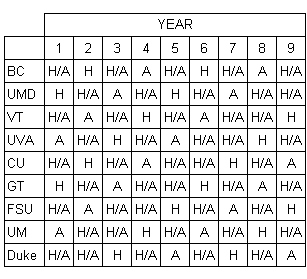
This would not be a terrible schedule. When compared to a complete round-robin, State would miss four games over a nine-year period against the nine rotating teams. Also note that the rotation was designed such that you never miss more than one game with any team over any two-year period. With the current 16 game schedule, you lose two games every three years.
The advantages to this system are:
– Keep the current primary partners for each school.
– Minimize the change that has to be sold to the various personalities involved (ie coaches and AD’s).
– No glaring disadvantages when compared to any other option.
I give this option >75% chance of being adopted by the ACC.
THE FAIREST OPTION
The most logical option would be to put all 11 teams on a rotating schedule to completely balance the schedule over time. For State, the schedule would look something like this:
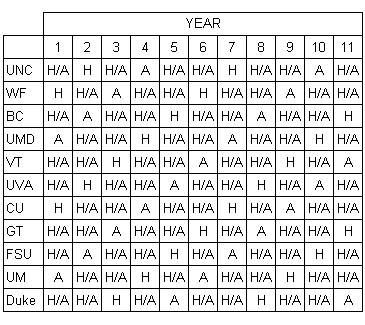
This schedule would mean that you would only miss four games over an 11-year stretch against each team in the conference (and no more than one game over any two years). If I were the ACC commissioner, this is the option that I would push for….which probably means that its chances of adoption are not very good.
One huge stumbling block to getting this accepted by the networks would be losing four Duke-UNC games over the 11-year rotation. The hype spewed forth twice each year suggests that this option would be opposed by the networks. Its overall fairness is a big plus, but I would give this option less than 25% chance of being adopted.
THREE PRIMARY PARTNERS
This is one that I would never have thought of, but I have seen it mentioned on various message board threads. This option is normally combined with the assumption that Duke would become State’s third primary partner. However, since I have gotten good seats in Blacksburg when State played there (and because I’m the one writing this), the following schedule assumes that State’s three primary partners are UNC, WF, and VT:
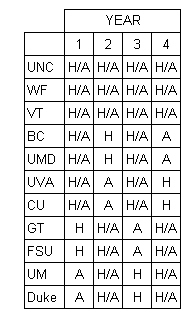
This option has exactly 0% chance of being used. Can you imagine the whining and gnashing of teeth over setting up the third primary partner for each school? The only reason that I even included it was so that it could serve as an intro into an even more bizarre scenario:
THREE GEOGRAPHY-BASED PARTNERS
A subset of the three primary partner scenario would be to rearrange the primary partners based on geography. This scenario goes like this:
1) Divide the conference into three geographical regions:
– North: BC, UVA, VT, UMD
– Central: UNC, NCSU, WF, Duke
– South: Clemson, GT, FSU, UM
2) Play two games every year against the teams in your region. In many instances, this would mean discarding at least one of the primary partners defined after ACC expansion.
3) Play two games against one of the other regions
4) Play a total of four games against the third region (two @ home and two away).
5) Alternate the games against the other two regions every year.
In table format, the three-region schedule would look like this for State:
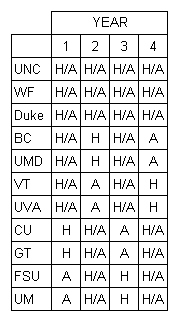
This option would be one of those rare moments in ACC history…something that you could get 100% agreement on. In other words, no school would favor this approach. This would get voted down quicker than the thought of using the football divisions (and cross-divisional rival) for setting the basketball schedule.
CONFERENCE STRENGTH OF SCHEDULE
Increasing the number of conference games would obviously tighten up the variability in conference SOS. Every once in a while, someone will get a nearly “perfect†schedule that is either harder or easier than “normal but more games should still work to minimize the difference between hardest and easiest schedules. When we get to this point, we’ll let our annual analysis document the variation and we can draw comparisons to the 16 game schedules.
CONFERENCE RPI
We’ve discussed this effect already, but I’m not convinced that a lower-ranking conference RPI will directly impact any of the ACC bubble teams. It seems to me that we’ve come up with a pretty good system for evaluating BCS bubble teams using:
– RPI
– Wins against RPI Top-50 (and Top-25)
– Conference Wins
– Conference Tournament Results
The bottom line is that losses against good teams don’t hurt a team’s chances of getting into the NCAAT. We can go back over State’s records from 2002, 2003, and 2005 to show that “good†losses (and even bad losses) don’t matter as long as you have some good wins along the way. (These three years also demonstrate how valuable wins in the conference tournament are.)
Note that I’m not going to disagree with the professors from the Dance Card. I’m just betting that Conference RPI works against mid-majors more than it helps the BCS schools.
CONCLUSION
I don’t see any drawbacks in expanding the ACC schedule to 18 games. Using either of the first two options would dramatically reduce the number of games “missed†versus a complete round-robin schedule. Since we will never see a round-robin schedule again, we have to hope for the next best thing. Plus…several more conference games from each team in December will certainly be better than nearly anything else shown on TV.
